


We love collaborating through challenges, big and small. If you're looking for a true partnership, we'd love to hear from you.

Image via: Jeremy Bishop on Unsplash
Design
Telling Your
ESG Story
with a Brand Lens
ESG is a topic that’s perpetually in flux – between progress and pushback, enthusiasm and skepticism. Many of the bold promises and performative metrics we saw set in the early 2020s are being stripped bare in today’s climate. Between reporting requirement rollbacks in the US1 and unaddressed delays in corporate impact reporting2, some companies are tiptoeing back from promises made just a few years ago, others are re-framing. Even some more firmly committed are swapping their ESG-forward language for more market-friendly buzzwords. Think less “sustainable” and more “efficient”, less “carbon neutral” and more “energy resilient.”
This doesn’t mean ESG is going away. Instead, for many, the story is shapeshifting.
While anti-ESG sentiment is increasingly vocalized among US stakeholders, the continued importance of these initiatives is top of mind for many consumers – research showing that many still agree that we are headed towards environmental disaster and that it’s important that they place the needs of others before their own.3 The ESG pushback is also not universal. In other global markets, such as in Asia, commitments remain robust.4 There is still rich opportunity for companies to translate their ESG efforts externally through brand storytelling – and if done in a credible and consumer-relevant way, to bolster hope and brand connection in a time of skepticism. So, let’s jump into it – and for the sake of this article not becoming a novel, I will be focusing primarily on the “environmental” component of ESG within the US.
A Balancing Act: Idealism & Real-World Benefits
The question becomes – not whether to talk about ESG, but how. Communicating progress without overselling is critical, missteps putting both brand equity and consumer trust at risk. Yet these initiatives are often technically complex, and consumers’ perceptions of what is “sustainable” doesn’t always align with what has true impact.
Take packaging materiality. Glass is widely hailed by eco-conscious consumers because it’s infinitely recyclable. But glass is also heavy (increasing shipping emissions) and, in practice, not always recycled.5 This conundrum illustrates why brand storytelling matters. It’s not only about what you’re doing, but how you explain tradeoffs in a way that feels both honest and relevant to your audience.
The first step is reconnecting with your consumer truths. Are they overwhelmed and defaulting to convenience? Are they value-driven and looking for small cost-saving changes in daily routines? Telling an ESG story through a brand lens means first tying your company’s efforts directly to the needs, anxieties, and motivations of your consumers.
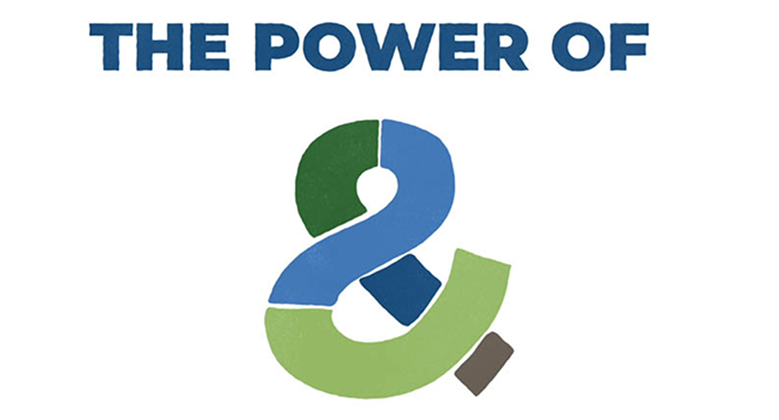
Image via P&G
Procter & Gamble’s “The Power of &” sustainability platform is a great example of how to make ESG relevant to your consumers’ everyday. Ranked #21 on Barron’s list of most sustainable brands in 2025.6 P&G anchors their E(SG) story in how their innovations improve consumers’ lives while also advancing their environmental goals. Two products they highlight include:
- Tide evo – A concentrated detergent that delivers on their 100% stain removal promise, works in cold water (saving consumers on energy bills), and comes in paperboard packaging that is more easily recyclable.
- Head & Shoulders Bare – A shampoo packaged in a bottle with 45% less plastic, making the bottle easier to squeeze. They’re delivering the same quality product that’s now more sustainable and more user-friendly.
P&G is consistent in serving up their ESG efforts as a plus up – addressing consumers’ core motivators AND addressing their progress. Their execution isn’t perfect – the messaging is broad enough in places to risk consumer skepticism – but the framework is strong. They’re balancing high-level vision with tangible product benefits and they’ve created a distinct visual system to communicate through. Their tools include hand-crafted illustrations, an earth-toned palette and clean data visualizations – and while they are leveraging expected eco-cues, they are doing a great job in simplifying complex ideas and conveying a family-friendly warmth that’s also present in many of their brands.
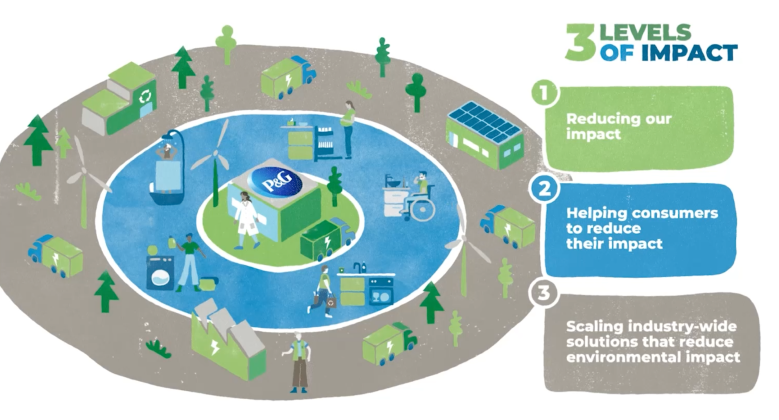
Image via P&G
P&G also leverages third-party collaborators to validate credibility. This strategy signals progress by association and is a shortcut that immediately builds trust due to the equity third-party brands have already built (while preventing the need for consumers to comb through every technical detail themselves.)
Growing Meaning Through Embedding ESG
Elevating ESG to a brand level cues commitment, strengthens differentiation, and provides powerful direction for brand growth. COTY is a lovely example of this, with their “Beauty that Lasts” platform. The credo evokes personal empowerment in embracing beauty through all stages of life while also indicating their attention to the environmental long game. Their platform clearly breaks down into the pillars of ESG by focusing on three areas – “the Beauty of our Planet, our People, and Governed Beautifully.”

Image via COTY
Their corporate identity is designed with this platform at the center, instead of relegating communication of their efforts to a single website tab or report PDF. They’re appealing to a changing consumer – emphasizing that "living sustainably shouldn’t mean sacrificing personal enjoyment.” Instead, their consumers are seeking businesses that support their values while still making space for creativity, imagination and humor. COTY’s design system blurs the boundaries between natural and unnatural, digital and physical to visualize the melding of natural elements with the beauty world they inhabit.
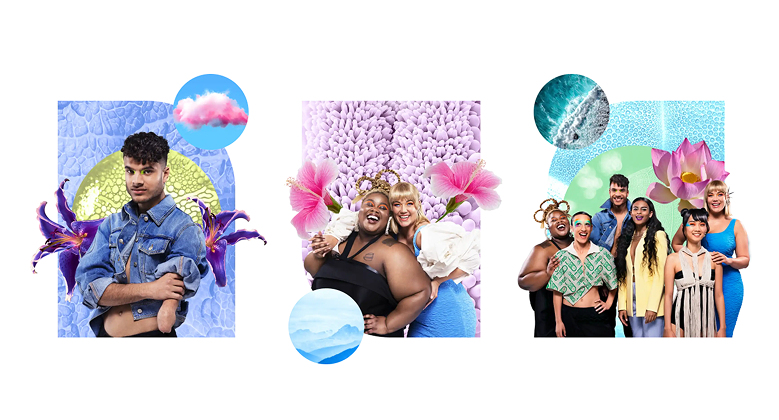
Image via COTY
They’re also working on making the contents of an ESG report more accessible – you can search topics here: https://www.coty.com/sustainability/esg-reporting-hub.
Shaping a Resonant Brand from Raw Materials
Ball Corp. comes in at #20 in Barron’s most sustainable companies of 2025 and boy does it show. They’re a B2B business with high brand name recognition due to their heritage, and are another stellar example of taking a truly brand-centric approach to communicating their initiatives – embedding them in every touchpoint.
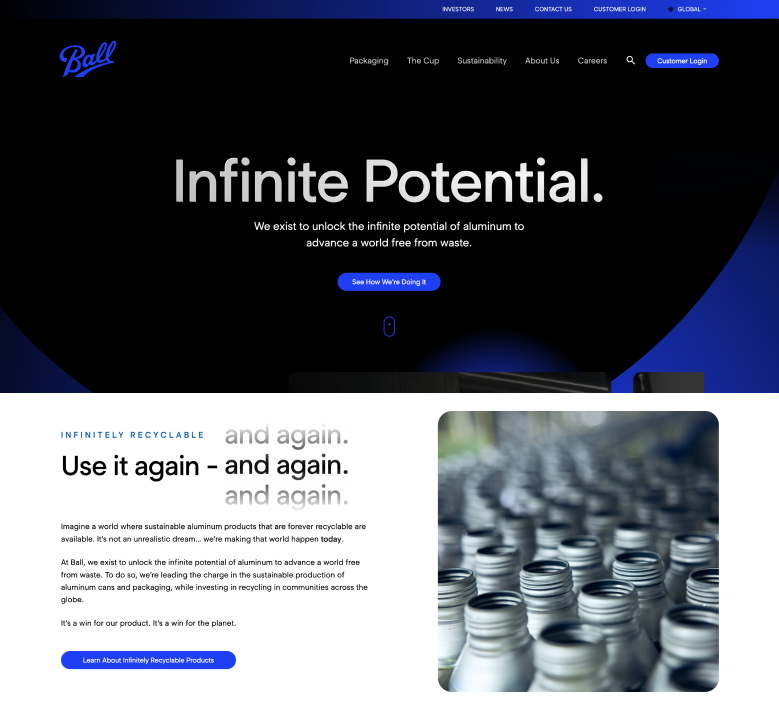
Image via Ball
The first thing that greets you on their website is their mission to “unlock the infinite potential of aluminum to advance a world free from waste.” There is a sense of urgency and ambition throughout the brand experience, all laddering up to this ultimate goal. Their aluminum materiality inspires a gorgeous, innovation-coded visual language full of texture, dramatic lighting, and heroic product shots – showing that sustainability can be communicated in a way that’s far beyond the “crunchy-granola” standard. Everything from their shape language to their text animations cue the circularity they so value.
The Stories Waiting to Be Told
We’ve looked at 3 companies that have crafted successful, brand-centric approaches to communicating their ESG initiatives. Candidly, finding even 3 great examples in this space wasn’t easy. Which begs the question – what about the dozens of other companies doing meaningful work in this space? Why are only a mere handful of Barron’s top 100 most sustainable companies of the year doing this well? On some we do see the starts of something, but the majority are using a copy/paste approach of stock photography of nature and generic messages like “envisioning a sustainable future.” This adds nothing to the texture of their brand and instead feels like a corporate box checked. Additionally, there are the hundreds of other companies that couldn’t even begin to tell these stories, because they haven’t yet done the work.
In this gap, there is an opportunity. Even as the tides around ESG continue to shift, companies have much to gain by anchoring their initiatives in business fundamentals,7 connecting with lived consumer needs, and building trust over repeated brand experiences. If done right, ESG communications can become so much more than a box to check or report to publish for investors. It can be a bridge to deeper consumer connection.
- ESG Today. U.S. EPA to Scrap Requirements to Report Greenhouse Gas Emissions. https://www.esgtoday.com/u-s-epa-to-scrap-requirements-to-report-greenhouse-gas-emissions/
- AdAge. US companies delay impact reports with DEI and ESG under attack https://adage.com/brand-marketing/aa-company-impact-reports-delayed-dei-esg/
- Ipsos. Environmental Sustainability: Setting the context. https://www.ipsos.com/en-us/knowledge/consumer-shopper/setting-context
- The Korea Times. Where is Asia’s ESG heading? https://www.koreatimes.co.kr/opinion/20251124/where-is-asias-esg-heading
- EPA. Glass: Material-Specific Data. https://www.epa.gov/facts-and-figures-about-materials-waste-and-recycling/glass-material-specific-data
- Barrons. Barron’s 100 Most Sustainable U.S. Companies 2025. https://www.barrons.com/lists-rankings/top-sustainable-companies/2025
- ESG Currents. Navigating Noise, Regulation, Risks in Late 2025. https://omny.fm/shows/esg-currents/navigating-noise-regulation-risks-in-late-2025